


Behavioral Engineering Script – The 30-Second Override to Stop Selling Successfully in 2026
I’ve been searching for technologies like these for decades. What I’m sharing below isn’t just a collection of phrases; it is a complete behavioral engineering script designed to replace standard sales pressure with psychological precision.
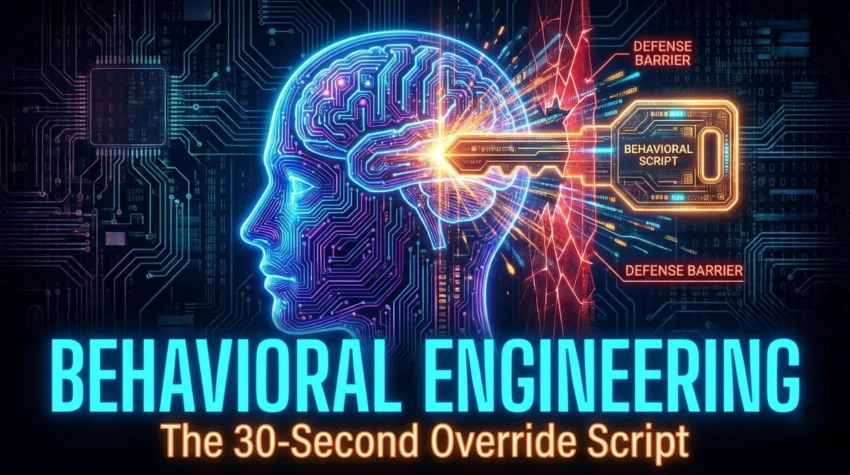
The 30-Second Override Script
Before you start copying or applying anything, I ask you one thing: read carefully. Don’t just skim the text; try to feel it. Try to live each step in your imagination. If you connect your emotions and try to mentally place yourself in the situations described, you’ll train not just your speech mechanics but also your psychology. And that’s 90% of the success.
This material is based on the methods of Chase Hughes and is adapted for conferences, networking events, and high-level events.
Part 1. Behavioral Engineering – Moving Beyond Sales
To approach a potential lead with the precision of a profiler and the authority of a university professor, we must abandon the concept of “sales” and embrace behavioral engineering.
In this framework, we’re not looking for a “customer.” We’re looking for a “subject” whose current psychological state is ineffective. Our task is to use Pattern Interrupts to disable their autopilot and Cognitive Dissonance to make your decision the only path to relief.
Fundamental architecture of the behavioral engineering script
Any successful contact is built on three pillars. Most people begin with a pitch. We begin with a question that forces the other person’s brain to search for an answer they don’t have. This creates a state of heightened suggestibility.

Why standard pitches fail
Below is a summary table explaining the mechanics of influence at each stage of this behavioral engineering script.
Anatomy of a behavioral script
| Step | Psychological task | The logic | Why it works |
|---|---|---|---|
| 1. The Jolt | Stop the brain’s “autopilot” and switch it to active search mode. | We ask about the underlying problem using specific terminology (e.g., “behavioral friction”). | The other person’s brain enters “search” mode, trying to understand the term. This causes instant silence and full attention. |
| 2. Identity Hook | Use the Linguistic Harvesting technique. | We appeal to who a person wants to be, not who they are now. We “label” them as a professional. | To disagree with you, someone will have to admit their own incompetence. They agree to avoid cognitive dissonance and save face. |
| 3. The Open Loop | Create scarcity and social credibility without selling directly. | We offer a “Blueprint” or “Diagram” instead of a banal presentation and offer to transfer it via AirDrop here and now. | AirDrop reduces physical and psychological distance. You go from stranger to trusted source in seconds. |
The table above shows the logic, but the execution must be fluid. It’s not about pausing between steps; it’s one continuous motion that bypasses the brain’s defensive perimeter. The diagram below illustrates how these three components work together to “pierce” the BS Detector and deliver your message directly to the decision-making center.

The Anatomy of the Script
The source code: the PCP model
Before we dive into the specific words, it is crucial to understand why this sequence hacks the brain so effectively. It relies on what behavior expert Chase Hughes calls the PCP Model (Perception → Context → Permission).
The video below explains the “operating system” behind the behavioral engineering script. Pay attention to how shifting someone’s Perception automatically changes their Context, which then grants them Permission to act differently.
[VIDEO EMBED: https://www.youtube.com/watch?v=9JjXoNiXYR0]
Notice the emphasis on Cognitive Dissonance. This is the engine of Step 2 (The Identity Hook). By labeling your prospect as a “visionary leader” or “data-driven expert,” you create a psychological gap they must fill by agreeing with you.
A detailed step breakdown
Now, let’s dive into each of the three steps so you understand not only what to say but also how it works at a neurobiological level.
Step 1: Pattern Interruption (“Shake”)
You’ve probably heard the word “AI” 50 times today. But notice how everyone talks about the “wow factor,” and no one talks about revenue recovery.
Script: “You’ve probably spent all morning making high-level strategic decisions. But have you identified the specific behavioral friction that’s currently eating up 20% of your ROI?”
Logic: By using the term “behavioral friction” (or any other non-obvious term), you make them feel like they should know it but don’t. This creates micro-stress and opens the door to your expertise.
Step 2: The Identity Hook (“Elicitation”)
Here we employ what Chase Hughes calls linguistic harvesting. We speak to the ideal self of the other person.
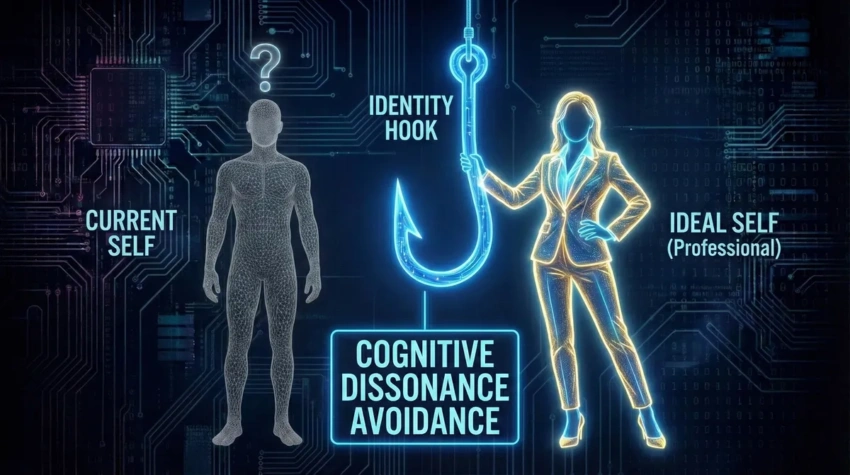
Targeting the “Ideal Self”
Script: “It’s rare to find a leader who values clinical precision over generic marketing noise. We’ve replaced manual lead generation with code-driven automation. It doesn’t just ‘find’ leads — it profiles them for relevance before you even see them. Essentially, we remove the human element from your revenue stream.”
Logic: You “label” the other person as someone who values precision. If they start arguing, they automatically acknowledge themselves as “noisy” and ineffective leaders. They are forced to agree with you to remain consistent within the identity you’ve given them.
Step 3: The Open Loop (“AirDrop”)
We never ask for a meeting. We offer a “Diagram” or “Architecture.” A PDF feels like spam. A “Blueprint” feels like insider information, like intel.

The Open Loop Strategy
Script: “I have a behavioral blueprint on my phone right now that we used to scale systems at [Industry Name]. It’s too proprietary to email, but if you’re interested, I can AirDrop it to you while we’re standing here.”
Logic: This is a Social Authority move. By claiming that information is “too valuable for email,” you elevate its status. By offering AirDrop, you break the “stranger” barrier.
3 nonverbal authority cues
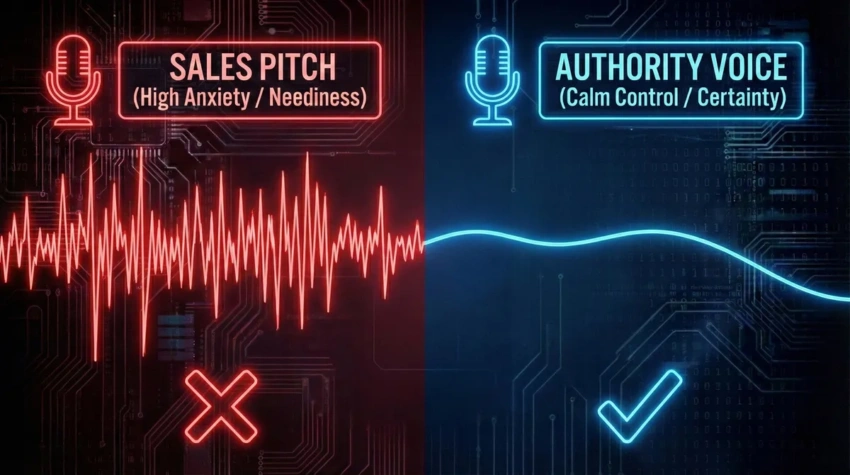
Sales Pitch vs. Authority Voice
Words are only half the battle. For this behavioral engineering script to work, you must master the delivery:
- Lowering pitch. A high-pitched voice signals a pleading stance. Lower your intonation at the end of your sentences. This is a signal of approval and authority.
- Tactical pause. After you asked the question in Step 1, wait 3 seconds. Let them sense the silence. The first person to break the silence is usually seeking approval. Let that be them, not you.
- Don’t fidget. In nonverbal language, “Authority is still.” Keep your hands visible and your posture open.
Part 2. Practice and Adaptation –
How to Avoid Sounding Like an Internet “Guru”
Before going “into the field,” you need to perfect your delivery. To master this behavioral engineering script, you must sound bored talking about big money. If you sound rehearsed, the behavioral engineering script will fail.

The AI Simulation Goal: Guru Mode vs. Authority Mode
To help you practice this state, I’ve prepared a special prompt for ChatGPT or Claude. Copy it and practice for 10-15 minutes.
1. Master prompt for practice (the interruption pattern)
This prompt will create a simulation where the AI plays the role of a skeptical executive, and you practice your composure.
- Role: you act as a mentor with dual personalities: behavioral expert Chase Hughes and a senior partner at McKinsey.
- Task: help me practice a 30-second behavioral engineering script based on a real-life case of recovering $10 million in lost revenue.
Scenario:
- “I bet you’ve heard about ‘AI’ 50 times today, but notice: everyone talks about the ‘wow factor’, and no one talks about revenue recovery.”
- “We just finished reengineering the internal logic for a client who recovered over $10 million in lost revenue. Clean code. No people involved. We didn’t change their marketing, we fixed their math.”
- “I have an architectural drawing of this solution on my phone. If you’d like to see the logic, I can AirDrop it before I go to the next section.”
Instructions for AI:
- Start a conversation like a distracted executive at a conference.
- Criticize my “clinical tone.” Since $10 million is a realistic number, I should say it with absolute boredom, as if it were any other Tuesday.
- Challenge me: Ask, “Only $10 million? That seems small for AI implementation.” (Help me practice “Recovery,” where I explain that $10 million is only the recovered leakage, not the total amount.)
- Start the simulation now.
When saying “$10 million,” don’t emphasize the word “million.” Say it flatly. If you sound excited, it implies that to you, this is a huge amount of money. If you sound bored, it implies that in your world, this is a small number. This makes you much more influential.
2. Adapting to skeptics (New York/New Jersey filter)
In big cities, people have a powerful built-in “BS detector.” If you sound too enthusiastic, like a typical “guru,” they’ll shut down.
Here are three keys to getting past this filter:
- “Night DJ” voice (by Chris Voss). Speak calmly, slowly, with a descending intonation. This transforms your words from a “sales pitch” to “insider information.”
- “No” question. Instead of asking permission (“Can I show you?”), use Voss’s logic: “Would you absolutely mind if I showed you a workflow that removes the human element?” People feel safe saying “No” (meaning “not against”); it gives them a sense of control.
- Physical anchor. When you suggest AirDrop, hold the phone like a specialized tool, not a toy. This reinforces the “Proprietary Intelligence” frame we established earlier.
Ready-Made Scenarios by Niche (Industries 1-5)
Below are adaptations of the behavioral engineering script for specific industries. Note how the terminology changes, but the structure (Shake-up -> Identity -> Open Loop) remains the same.
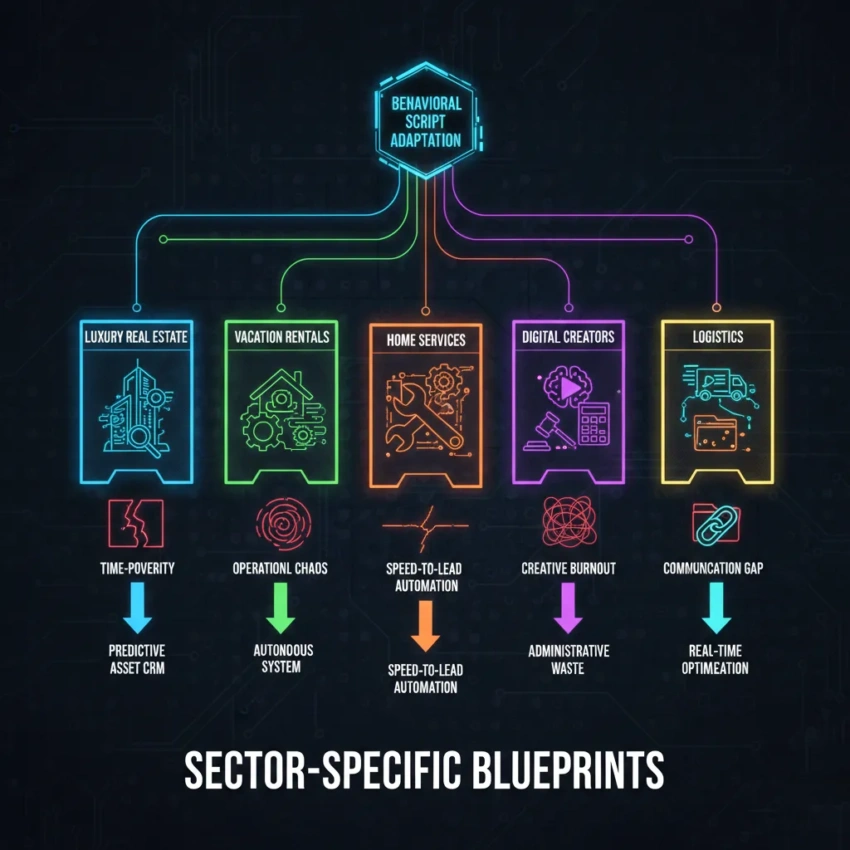
Sector-Specific Blueprints: Adapting the Core
Industry 1: real estate (luxury / investments)
The goal is to exploit the “time-poverty” of top agents.
- Step 1 (Shake-up). “You’ve clearly mastered the art of closing deals, but have you considered the cognitive energy drain spent on filtering out low-intent leads?”
- Step 2 (Identity Hook). “It’s great to meet a broker who views their pipeline as a technical architecture, not just a numbers game. We’ve automated the profiling phase, so the machine isolates ‘ready-made’ signatures before your team even picks up the phone. This effectively turns CRM into a predictive asset.”
- Step 3 (Open Loop). “I have a visual map of the ‘Predictive Lead Architecture’ we use for portfolios in Manhattan. It’s a bit sensitive for public sharing, but I can AirDrop the diagram if you’d like to see the logic.”
Industry 2: vacation rentals
Here, the aim is to solve the problem of operational chaos at scale.
- Step 1 (Shake). “Management at this level is impressive, but have you identified a specific operational ‘drift’ where manual guest communication is actually eroding your margins?”
- Step 2 (Identity Hook). “You sound like an operator who demands frictionless scaling. We’ve built an ‘autonomous nervous system’ for real estate workflows — it automates the entire marketing-to-service cycle, so the business doesn’t need your physical presence to remain profitable.”
- Step 3 (Open Loop). “I have a ‘Seamless Scaling Blueprint’ for the 2026 market on my device. I can’t email it for privacy reasons, but I can AirDrop the logic to you right now.”
Industry 3: home services (HVAC, repair, construction)
The behavioral engineering script here facilitates the transition from “Blue Collar” to “Tech Enterprise” status.
- Step 1 (Shake). “You have machines on the line, but have you measured the loss of ROI that occurs between the initial lead ‘ping’ and the actual dispatch of a technician?”
- Step 2 (Identity Hook). “You manage this with more precision than many tech founders I know. Most companies in your industry lose money in the ‘response gap.’ We’ve automated the bridge from marketing to the control room, so the customer is emotionally locked in before your competitor even checks their email.”
- Step 3 (Open Loop). “Actually, I have a field-tested ‘Speed-to-Lead’ automation flowchart on my phone. If you’re near your device, I can send it to you so you can see where your gap is now.”
Industry 4: digital creators and media agencies
Applying the behavioral engineering script to creators requires addressing “Creative Burnout” and manual labor.
- Step 1 (Shake-Up). “Your content is top-notch, but have you identified the technical bottleneck that’s preventing your creative output from scaling at the same rate as your audience?”
- Step 2 (Identity Hook). “It’s rare to find a creative who understands that ‘Creative’ is a process and ‘Distribution’ is a mathematical problem. We’ve built an AI-powered marketing engine that automatically repackages and deploys your IP. It treats your content as a repeatable software product, not a one-off post.”
- Step 3 (Open Loop). “I have a visualization of the ‘Content-to-Capital’ workflow we use for high-growth channels. I can AirDrop the stack breakdown if you’re interested.”
Industry 5: professional services (lawyers/accounting)
The goal is to focus on “Billable Hours” vs. “Administrative Waste.”
- Step 1 (Shake). “Your hourly rate is solid, but have you considered the ‘hidden’ cost of your firm’s administrative friction?”
- Step 2 (Identity Hook). “You operate with a level of clinical rigor that most firms lack. We’ve replaced manual client onboarding and follow-up with a behavioral automation sequence. This ensures that by the time you connect, the client is already pre-screened and ‘warmed up’ to your authority.”
- Step 3 (Open Loop). “I have a blueprint for the ‘Clinical Intake’ automation here. It’s too high-level for a general distribution, but I can AirDrop it to you as we speak.”
Part 3. Scaling and Specialized Niches
We continue our analysis of how to apply the behavioral engineering script to specialized sectors. If your niche is technology, manufacturing, or retail, the following examples will form your foundation.
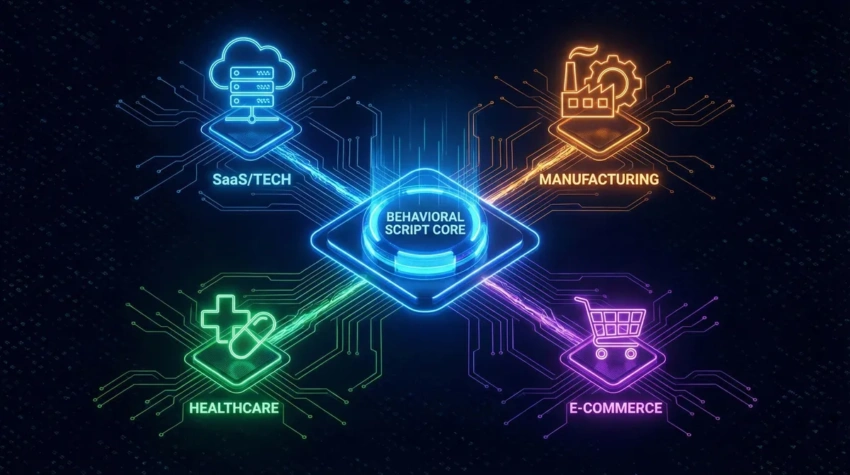
Universal Application: One Logic, Many Niches
Industry 6: e-commerce founders
The final point is to solve the “Scaling Wall” and rising CAC (customer acquisition cost).
- Step 1 (Shake). “The brand is scaling, but have you identified that specific point in the funnel where your customer acquisition cost (CAC) is artificially inflated by manual marketing efforts?”
- Step 2 (Identity Hook). “You’re clearly building an ecosystem, not just a store. Most people just ‘buy advertising,’ but you seem to understand that the profit lies in automating the retention cycle. We’ve coded systems that trigger marketing based on behavioral signals, removing the human lag from the sales cycle.”
- Step 3 (Open Loop). “I have a ‘Behavioral Retention Map’ on my phone — it’s the logic behind some major New York City brands. I can AirDrop it if you want to see the consistency.”
Industry 7: manufacturing / B2B supply chain
Here, you have to focus on efficiency and updating legacy systems.
- Step 1 (Shakeup). “Operations are large, but have you identified the one legacy process that’s currently acting as an ‘anchor’ to your quarterly growth?”
- Step 2 (Identity Hook). “You have the mindset of a systems engineer. You know that any manual data entry is a single point of failure. We specialize in ‘pipeline cleaning’ — automating the communication between your sales team and the production line so your business moves at the speed of code.”
- Step 3 (Open Loop). “I have a Legacy-to-Logic flow map that we use for high-volume B2B. I can send you a PDF if you’re interested in the architecture.”
Industry 8: health and wellness / private clinics
When adapting the behavioral engineering script for private clinics, the aim is to deal with patient experience and burnout.
- Step 1 (Shake). “You provide elite care, but have you eliminated the behavioral friction in patient onboarding that’s causing your no-show rate to stagnate?”
- Step 2 (Identity Hook). “You approach your practice with the same precision you bring to treating patients. We’ve developed ‘Nurture-to-Appointment’ automation that manages the patient’s psychology before they walk in the door. This ensures they’re compliant (willing to follow instructions) without any intervention from your staff.”
- Step 3 (Open Loop). “I have a ‘Patient Compliance Flowchart’ that shows exactly how to automate trust building. I can AirDrop it right now.”
Industry 9: SaaS / tech startups
The goal of the behavioral engineering script in this sector is to highlight time-to-market and burn rate.
- Step 1 (Shakeout). “The product is solid, but have you identified the specific ‘technical debt’ that is crippling your ability to pivot in six months?”
- Step 2 (Identity Hook). “You’re a founder who values architecture over quick fixes. Most teams just ‘write code,’ but you seem to want an automated development lifecycle for instant, bug-free deployment. We’re building a ‘factory’ that builds the product.”
- Step 3 (Open Loop). “I have our ‘Agile Automation’ framework — that’s how we reduced development cycles by 40%. It’s too technical for social media, but I can AirDrop this whitepaper.”
Industry 10: logistics and delivery services
Finally, your target here is real-time optimization.
- Step 1 (Shake). “You’re moving large volumes, but have you isolated that specific communication gap between the control room and the last mile that’s draining your profits?”
- Step 2 (Identity Hook). “You’re a strategist who understands that in logistics, seconds are dollars. We’ve automated ‘exception handling’ in the delivery chain. When a problem arises, the system corrects it before a human driver even realizes there’s a delay.”
- Step 3 (Open Loop). “I have a Zero-Lag Logistics logic map. I can send it to your phone if you’d like to see how automation handles routing.”
How to Implement This Today
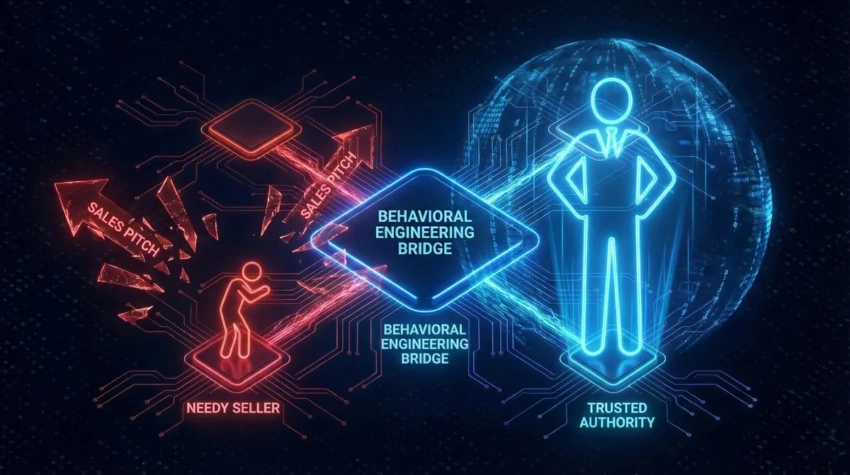
Crossing the Bridge: From Pitch to Prescription
You now have 10 variations of the behavioral engineering script and a solid psychological foundation. Now the ball is in your court. But remember: knowing the script doesn’t produce results. The result is the state from which you utter it.
Your action plan (checklist)
- Choose your niche. Don’t try to learn everything. Choose one script that resonates with your activities.
- Prepare an “Artifact”. Create a real PDF or image titled “Blueprint” or “Architecture Map.” Keep it on your phone. Without it, “Open Loop” (Step 3) won’t work.
- Train with the AI. Use the Master Prompt from Part 2. Get the AI, in the role of the skeptic, to say, “Sounds intriguing, show me what you’ve got.”
- Watch your tone. Record yourself. If you sound like a salesperson (“Buy from me!”), rework it. You should sound like a tired surgeon who knows the diagnosis better than the patient.
People don’t buy from those who need a deal. They buy from those who have a grasp of reality. This behavioral engineering script is your tool for capturing your interlocutor’s reality in 30 seconds. Its power lies not in the words, but in the authority of the speaker. Go and practice!
Updated on: . Author: